New York’s Street Design Movement Shows How Political Campaign Backdrops Can Champion Environmental Justice
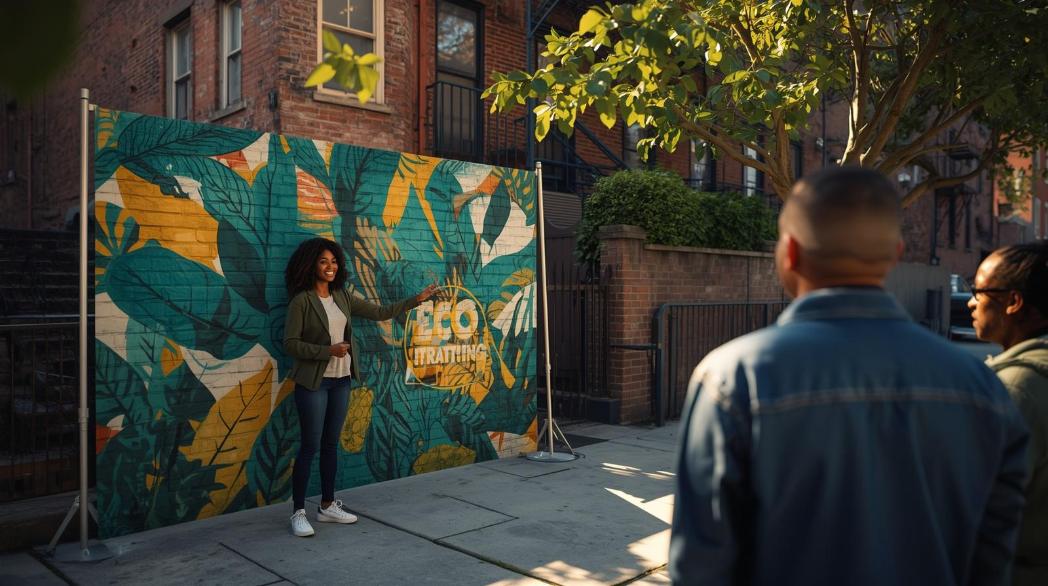
A few months ago, while walking through a busy part of Queens, I noticed something unusual. A political campaign backdrop NYC had been taped onto a brick wall along a crowded sidewalk.
The display that people gathered around in NYC was not the usual kind with just a candidate’s name. Instead, it was filled with bright green colors, pictures of trees, and symbols of a clean environment. A kid on a scooter even stopped, pointed at the green leaves, and told his friend, “That one looks like a park.”
That moment stayed with me. It felt small at the time, but it said something interesting about politics in the city. Political visuals in New York seem to be moving away from the rigid podium style toward something more connected to people and the environment.
Street corners, walls, and temporary campaign stages are slowly becoming a canvas for environmental justice.
Roads as a Narrative
New York City is full of visual noise. Storefront advertisements compete with subway posters and murals that have been painted over decades. Political campaign ads used to blend into that chaos.
Lately, campaign designers seem to be borrowing from the city’s artistic culture. Posters behind candidates speaking in neighborhoods now feature bright colors and hand drawn designs.
At a community cleanup in Brooklyn, a volunteer made a simple but sharp observation. “If a backdrop looks like a school bulletin board, no one notices it. But if it’s a mural, people stop.”
She was right. Visual energy draws people in. And once people stop, conversations start. Air quality. Trees. Bike lanes. Local parks. The topics flow naturally.
Environmental Messages in Plain Sight
Environmental justice can feel abstract when it only appears in reports or council meetings. But when a candidate speaks in front of images of river waves, sunlit skylines, or community gardens, the message becomes easier to see.
Street design can help tell the story of a community. A backdrop filled with green tones might remind residents of the trees in a nearby park. A neighborhood focused on protecting waterways might choose banners with flowing blue shapes.
At one neighborhood event, a local resident joked, “The sign makes the speech easier to understand.”
What she meant, I think, is that visuals help simplify complicated ideas like policy and regulation. When the street itself becomes part of the message, politics becomes easier to grasp.
A City Learning From Its Walls
The shift also reflects how political campaigns are learning from New York’s long tradition of public art. Murals about climate resilience and waterfront restoration have already shaped how communities talk about the environment.
Bright colors. Natural textures. Sometimes even recycled materials. Instead of sterile stages, these campaign spaces begin to reflect community identity.
At the end of one event, a participant pointed at the painted leaves on a campaign banner and said, “If we want greener neighborhoods, maybe our politics should look green too.”
It sounded simple, maybe even a little naive. But maybe that is the point.
Visual design alone cannot fix environmental injustice. Still, the setting matters. When political events visually reflect the future people hope for, cleaner streets, healthier parks, stronger neighborhoods, the conversation changes.
Toward the end of many campaign gatherings, volunteers begin talking about future projects and community initiatives. Green and sustainable marketing often becomes part of those discussions, encouraging people to imagine what a healthier city could look like.
At that moment, you start to realize something. The backdrop behind the speaker is no longer just decoration. It becomes a glimpse of the city people want to build.