Sustainable Australian Gardens: How Thoughtful Landscaping Can Support Urban Biodiversity
Australia supports hundreds of thousands of native species, and a large proportion of them occur nowhere else on Earth. The Australian State of the Environment report estimates that about 85 per cent of the country’s plant species are endemic. Protecting this biological richness is often associated with national parks and conservation reserves, but residential gardens can also help wildlife survive within growing cities and suburbs.
Outdoor construction and landscaping decisions influence how much habitat, shade, and usable soil remains around a home. Companies involved in these projects, such as Master Groups, may work with design choices involving planting areas, paving, fencing, drainage, and outdoor structures. When sustainability is considered during planning, these features can be arranged to support local environmental goals without suggesting that a contractor holds a particular environmental certification.
Why Biodiversity Matters in Australian Suburbs
Urban development changes the natural landscape by replacing vegetation with roofs, roads, driveways, and other hard surfaces. This can divide habitats into smaller areas, making it harder for birds, insects, reptiles, and mammals to find food, water, and shelter.
Australia’s Department of Climate Change, Energy, the Environment and Water reports that almost half of the country’s nationally listed threatened animal species and around one-quarter of its threatened plant species occur in urban areas. This means biodiversity protection is relevant within cities as well as remote natural environments.
A single garden cannot replace a healthy bushland ecosystem. However, gardens, street trees, parks, waterways, and planted verges can form connected patches of habitat. Together, these spaces may help wildlife move through developed neighbourhoods.
Choose Plants Suited to the Local Area
Native planting is one of the most practical ways to improve the ecological value of a residential property. Australian plants have adapted to varied climates, nutrient-poor soils, and local fire conditions, as documented by the Australian State of the Environment.
Plant selection should still be based on local conditions rather than simply choosing any species labelled Australian native. A plant that grows naturally in tropical Queensland may be poorly suited to a dry South Australian garden or a cooler property in Victoria.
Locally native species are more likely to provide useful food and shelter for wildlife found in the surrounding area. Greening Australia notes that flowering natives such as banksias, correas, grevilleas, and kangaroo paws can supply nectar, seeds, and habitat for birds, insects, and other animals. The best choices depend on soil, rainfall, sunlight, available space, and local council guidance.
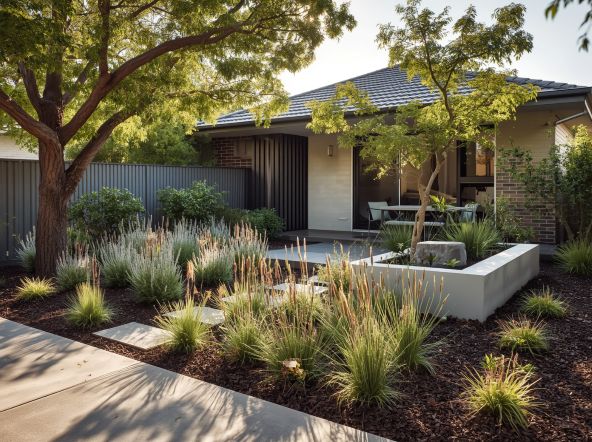
A layered garden can offer greater habitat variety than a lawn bordered by a single hedge. Where space allows, homeowners can combine:
- Native ground covers and grasses
- Flowering shrubs for insects and nectar-feeding birds
- Dense plants that provide shelter
- Small trees suited to residential blocks
- Seasonal flowers that maintain food sources throughout the year
Use Shade Trees to Reduce Urban Heat
Australian cities are experiencing increasing pressure from extreme heat. Built surfaces absorb solar energy during the day and release it slowly, contributing to the urban heat island effect. Homes with limited vegetation can become especially uncomfortable during summer.
Research from the Commonwealth Scientific and Industrial Research Organisation, commonly known as CSIRO, shows that urban greening can make built environments cooler and more comfortable. A 2025 CSIRO study in Darwin found that shaded surfaces could be considerably cooler than nearby surfaces exposed to direct sun.
Well-positioned trees can shade patios, walls, windows, and paved areas. They may also provide nesting sites, flowers, fruit, or protective cover for wildlife. Species must be selected carefully, with mature height, canopy spread, root growth, overhead powerlines, underground services, and nearby structures taken into account.
Replace Excessive Hard Surfaces With Permeable Options
Large areas of concrete and sealed paving prevent rainfall from soaking naturally into the ground. Water then flows across the surface, carrying soil, litter, chemicals, and other pollutants towards drains and waterways.
Permeable paving allows some water to pass through the surface and enter the soil or a prepared drainage layer below. The NSW Government’s Urban Green Cover Technical Guidelines identify gravel and porous or permeable paving systems as options for supporting water infiltration.
Depending on site conditions, these materials may be suitable for garden paths, courtyards, low-traffic areas, or sections of a driveway. Proper installation is essential because soil type, slope, drainage capacity, traffic loads, and maintenance requirements affect performance.
Plan Gardens Around Water Availability
Australia’s rainfall patterns differ greatly between regions, and many communities regularly face water restrictions or extended dry periods. A sustainable garden should therefore be planned around the amount of water that can realistically be supplied.
Grouping plants with similar water needs can make irrigation more efficient. Mulch can reduce evaporation and protect the soil, while drip irrigation delivers water closer to plant roots. Rainwater tanks, rain gardens, swales, and suitable drainage systems may also help keep more rainfall on the property.
Water-sensitive design should remain specific to the site. Poorly positioned garden beds or drainage features can direct water towards buildings, neighbouring properties, or unstable ground. Local regulations and professional advice may be needed before altering drainage patterns.
Create Small Habitats for Local Wildlife
Wildlife-friendly gardens need more than flowers. Animals require water, shelter, nesting spaces, and protection from disturbance. Small changes can improve habitat without making a garden look untidy or difficult to maintain.
Useful features may include:
- Shallow water dishes placed where they can be cleaned regularly
- Dense shrubs where small birds can shelter
- Rocks or logs that provide refuge for insects and lizards
- Plants that flower at different times of the year
- Reduced pesticide use where safe and practical
Care is needed when encouraging wildlife. Water containers should not be allowed to become mosquito breeding sites, and feeding wild animals can create nutritional or behavioural problems. Habitat planting is generally more sustainable than providing processed food.
Balance Sustainability With Safety and Function
Residential landscapes must still meet everyday needs. Paths should be stable, outdoor areas should be accessible, and plants should not block sightlines or damage structures. Properties in bushfire-prone areas may also require vegetation management and defendable-space measures that differ from designs used in lower-risk suburbs.
Sustainable planning is therefore a balancing process. A successful design considers biodiversity alongside water use, fire risk, drainage, maintenance, privacy, recreation, and the available budget.
READ ALSO: How Structured Property Clearance Supports Urban Recycling and Waste Reduction in Vienna
Building Greener Australian Neighbourhoods
Urban biodiversity depends on connected action across private gardens, public parks, waterways, streets, and remaining bushland. Greening Australia describes urban habitat restoration, tree-canopy expansion, improved water quality, and wildlife corridors as important parts of creating more resilient cities.
Homeowners do not need to transform an entire property at once. Replacing a small section of paving, planting a locally native shrub, retaining an appropriate mature tree, or improving rainwater management can be a useful starting point.
As Australian cities grow and temperatures rise, thoughtful landscaping can help residential properties remain comfortable, functional, and connected to the natural environment. Decisions made around plants, shade, water, materials, and habitat may appear small on one block. Across a neighbourhood, however, they can contribute to greener urban spaces that support both people and Australia’s distinctive wildlife.